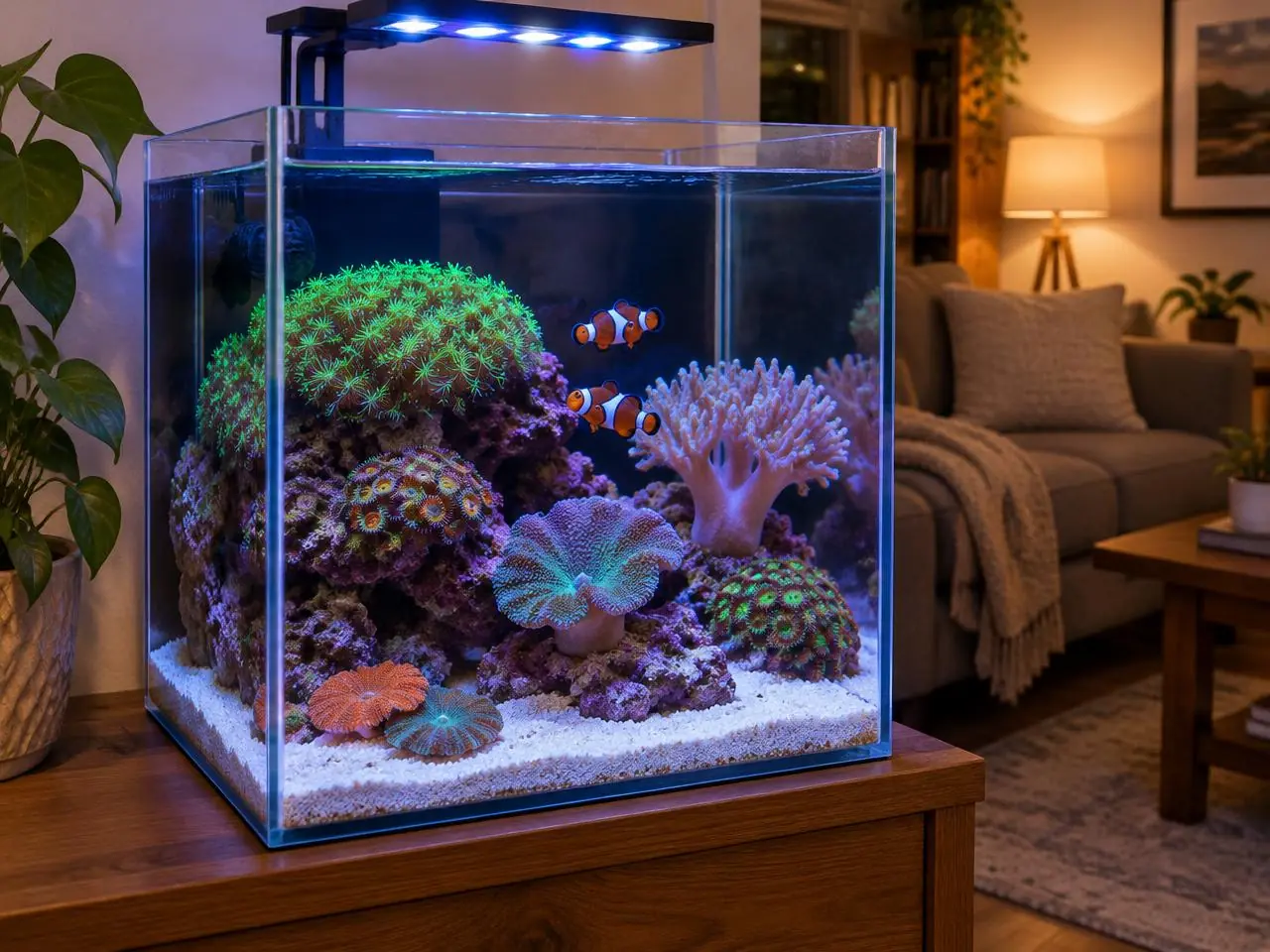
Clean the house without putting the reef at risk. Where a product is used matters just as much as what is in the bottle.
No household cleaner belongs in a stocked tank
Inside a tank with fish, coral, invertebrates or biological filtration, use aquarium-only mechanical tools—not soap, vinegar, citric acid, bleach, peroxide or disinfectants as cleaning additives. “Natural,” “pet-safe” and “ammonia-free” do not mean safe for aquatic life.
Choose by location
What can I use, and where?
These are safer methods with specific limits, not a blanket approval for chemicals near an open aquarium. Check the exact label and material compatibility every time.
Inside a stocked tank · tools only
Aquarium-only algae pad or magnetic cleaner
Use a pad made for your tank material: glass and acrylic need different tools. Keep sand out of magnets to avoid scratches. Never use a kitchen sponge, soap-treated pad or household cleaning eraser.
Inside a stocked tank · tools only
Dedicated siphon, brush & bucket
Remove debris mechanically with tools that have never held detergent or other household chemicals. Siphon waste into an aquarium-only bucket. Do not scrub or replace all biological media at once; gently rinse media in removed tank water when needed.
Outside surfaces only
RODI water & a clean microfiber cloth
The first choice for outside glass, salt creep and the nearby stand. Dampen a dedicated, residue-free cloth and wipe; follow the stand finish instructions. Do not spray toward the tank. Keep drips away from outlets and power strips. Plain fresh water is for exterior wiping, not a cleaning dose in saltwater.
Removed equipment or empty tank only
Plain white vinegar — removed parts only
Useful for mineral scale on compatible, unplugged removable parts or empty aquarium surfaces. Check the equipment instructions first; do not assume every seal, metal or acrylic part tolerates acid. Use a separate container, keep all runoff out of the aquarium, rinse thoroughly with clean water and give a final RODI rinse before returning compatible parts. Never soak live rock, coral, sand or biological media.
Removed equipment or empty tank only
Aquarium equipment citric-acid descaler
Choose an unfragranced product specifically intended for aquarium equipment and follow its label for dilution, contact time and material compatibility. Unplug and remove the part before soaking. Rinse thoroughly and finish with RODI water. Never pour the cleaning solution into an occupied aquarium or sump.
Outside surfaces only
Aquarium exterior glass or acrylic cleaner
Use only a product explicitly labeled for the outside of your aquarium material, following its directions. Exterior-safe does not mean safe in the water. Apply to a cloth away from the aquarium rather than misting the tank; keep it off rims, seams and openings and prevent runoff.
Household surfaces away from the tank only
Unscented, non-spray household detergent
For necessary household cleaning away from the aquarium only, not tank surfaces or aquarium tools. Choose a non-aerosol formulation suitable for the surface, follow its label, apply to a cloth away from the tank and prevent splashes, residue transfer and runoff. Even unscented or plant-based detergents can damage gills: none is guaranteed safe around an open tank.
Empty-tank disinfection is a separate job. Bleach can be used in specific empty-equipment disinfection protocols, but is not routine reef cleaning. Get a product- and material-specific plan, including thorough rinsing and chlorine removal, before reuse. Never disinfect established biological media or anything carrying livestock.
Around the aquarium
A lower-risk household cleaning routine
Water and a dedicated cloth are the first choice nearby. A necessary household cleaner stays on household surfaces away from the tank—never in tank water.
01
Start with water, not a spray
For dust and routine salt creep, use a RODI-dampened cloth. Keep separate, clearly marked cloths and buckets for housework and aquarium work; avoid fabric-softener or cleaning-product residue on tank cloths.
02
Keep the whole water path protected
Remember the sump, overflow, top-off reservoir and mixing containers, not just the display. Do not clean above open water. A brief splash barrier may help with wiping, but do not seal the aquarium or block cooling and gas exchange.
03
Apply elsewhere & ventilate safely
If a household product is necessary, use it away from the aquarium and apply to a cloth rather than spraying into the room. Ventilate without directing contaminated air toward tanks or air intakes. Never mix cleaners: bleach with vinegar/acids or ammonia can release dangerous gas.
04
Treat shared air as tank air
A different room is not automatically safe when doors, hallways or heating and cooling connect the air. Keep unnecessary fragrance, smoke and fumes out of the home's shared airflow. If a necessary product is used elsewhere, close off the area and ventilate outdoors away from tank and air-pump intakes; there is no universal safe waiting time.
05
Clean your hands before tank work
Wash hands, rinse all soap away thoroughly and dry with a clean towel. Avoid lotion, sanitizer, sunscreen, perfume or pet flea-treatment residue on hands and arms. Use clean aquarium-dedicated gloves when appropriate; gloves must also be free of chemicals.
Protect every opening and air intake—not only the glass you can see.
Prevent a tank crash
Keep household fumes, sprays and residues away
There is no universal safe distance or waiting time for candles, incense, smoke, fragrance or sprays. Formulation, airflow, tank openings and livestock sensitivity all affect exposure. A closed lid does not make these hazards safe.
Bug sprays, flea treatments & foggers
Many insecticides, including permethrin and other pyrethroids, are highly toxic to aquatic life. Do not spray in the aquarium room. Tell pest-control professionals about every aquarium and follow their product-specific protection or relocation plan; a lid alone is not protection from fumigation.
Candles, incense & fireplace smoke
Do not burn scented or unscented candles, incense, sage, wood or other materials in the aquarium room or near air-pump and skimmer intakes. Burning adds smoke, fine particles and airborne compounds to the room. Shared heating and air-conditioning can carry them between rooms, and blowing out a candle does not immediately clear the air.
Smoking, vaping & cooking fumes
Keep cigarette, cigar and cannabis smoke, vape aerosol, frying smoke and aerosol cooking sprays away from aquariums and their air intakes. Smoke, oily droplets and residues can spread through shared air and contaminate water or equipment. Vent cooking fumes outdoors, never toward the tank; an air purifier is not a guarantee of safety.
Air fresheners, fragrance & essential oils
Avoid aerosol fresheners, room mists, plug-in fragrances, wax melts, oil diffusers, perfume, hairspray and spray deodorant near tanks. Droplets, vapors and residues can reach water, and skimmers and air pumps can draw contaminated room air into the system. Natural fragrance and essential oils are not safety guarantees.
Glass sprays, polish & disinfectants
Keep ammonia glass cleaners, bleach sprays, alcohol sprays, furniture polish, degreasers and disinfectant wipes away from tank openings and equipment. Ammonia-free, pet-safe, green and reef-safe marketing alone do not establish safe exposure for fish, coral or invertebrates.
Laundry detergent, softener & dryer sheets
Never wash aquarium towels, filter bags or filter socks with household laundry detergent, fabric softener, fragrance boosters or dryer sheets. Residues can transfer into the water. Keep tank laundry separate and use a residue-free cleaning process appropriate for the item; when in doubt, replace it rather than risking contamination.
Carpet powders, floor polish & spray cleaners
Do not shake carpet powders or spray foam, stain remover, oven cleaner, floor finish or polish near an aquarium. Fine particles and mists can drift into open water and settle on equipment. Use necessary household products away from the tank, applied to a cloth where possible, and keep hands and tools free of residue.
Paint, solvents & DIY fumes
Plan painting, varnish, nail-polish remover, adhesives, solvent work or fumigation with qualified help before it begins; do not rely on simply turning off the air pump. Use only aquarium-appropriate sealant on tank equipment and cure it fully as directed away from livestock. Never boil, steam, pressure-wash or heat live rock or zoanthids/palythoas: hazardous toxins may become airborne.
Household ozone generators
Do not run a household ozone generator in an occupied room or use one as a substitute for source control and ventilation. Ozone is a reactive gas that can harm people and animals. Controlled aquarium ozone equipment is a separate, specialized setup and must never be improvised with a room-treatment machine.
Suspected contamination
Act promptly—do not wait for fish to die
Rapid breathing, gasping, frantic swimming, unusual surface foam or many corals closing at once after cleaning, fragrance use, smoke or fumes can signal a problem. These signs are not a diagnosis; take the exposure seriously.
01
Stop the source — protect people first
If it is safe, stop the spraying, smoking or burning and keep any product container or label for identification. Leave an unsafe room and seek emergency help for fumes or breathing symptoms. Do not put your face over contaminated water or mix chemicals to neutralize a spill.
02
Support oxygen with clean air
Once the room is safe, maintain circulation and add aeration from a clean air source if possible. An air pump or skimmer in contaminated air can keep introducing the chemical; get immediate guidance on protecting its intake without leaving fish oxygen-starved.
03
Remove contamination & change water
Using clean equipment and safe handling, remove obvious contaminated material. Start a substantial water change with clean, fully mixed saltwater matched to temperature and salinity; repeat as advised for the product and exposure. Do not add random antidotes, extra medications or freshwater to a reef.
04
Use fresh carbon & get urgent help
Fresh aquarium activated carbon may help remove some organic contaminants, but does not remove every chemical or guarantee recovery. Call the shop or an aquatic veterinarian promptly with the exact product, estimated exposure and symptoms; do not wait for losses. Ordinary water tests cannot rule out detergent or pesticide contamination. Monitor breathing, ammonia and salinity while following a specific recovery plan.
For human poisoning concerns in the U.S., call Poison Control at 1-800-222-1222; call 911 for severe symptoms. The shop is not an emergency medical service.
General prevention guidance—not a guarantee of safety or a substitute for a product label, aquatic veterinary advice or an exposure-specific recovery plan.
Talk to a real reefer
Looking for a coral or fish? Give us a call.
We'll tell you what's in stock today, ship it to you (in-store stock is first come, first served), and help you plan your tank. Open Monday–Saturday 11 AM – 7 PM, Sunday 12 PM – 5 PM.