Testing phase · purchases coming soon

Coral spot feeding

Feed your corals the right way.

Light keeps corals alive, but feeding makes them grow and color up. Here's what each coral likes to eat, how often, when to feed and how to do it without fouling your water.

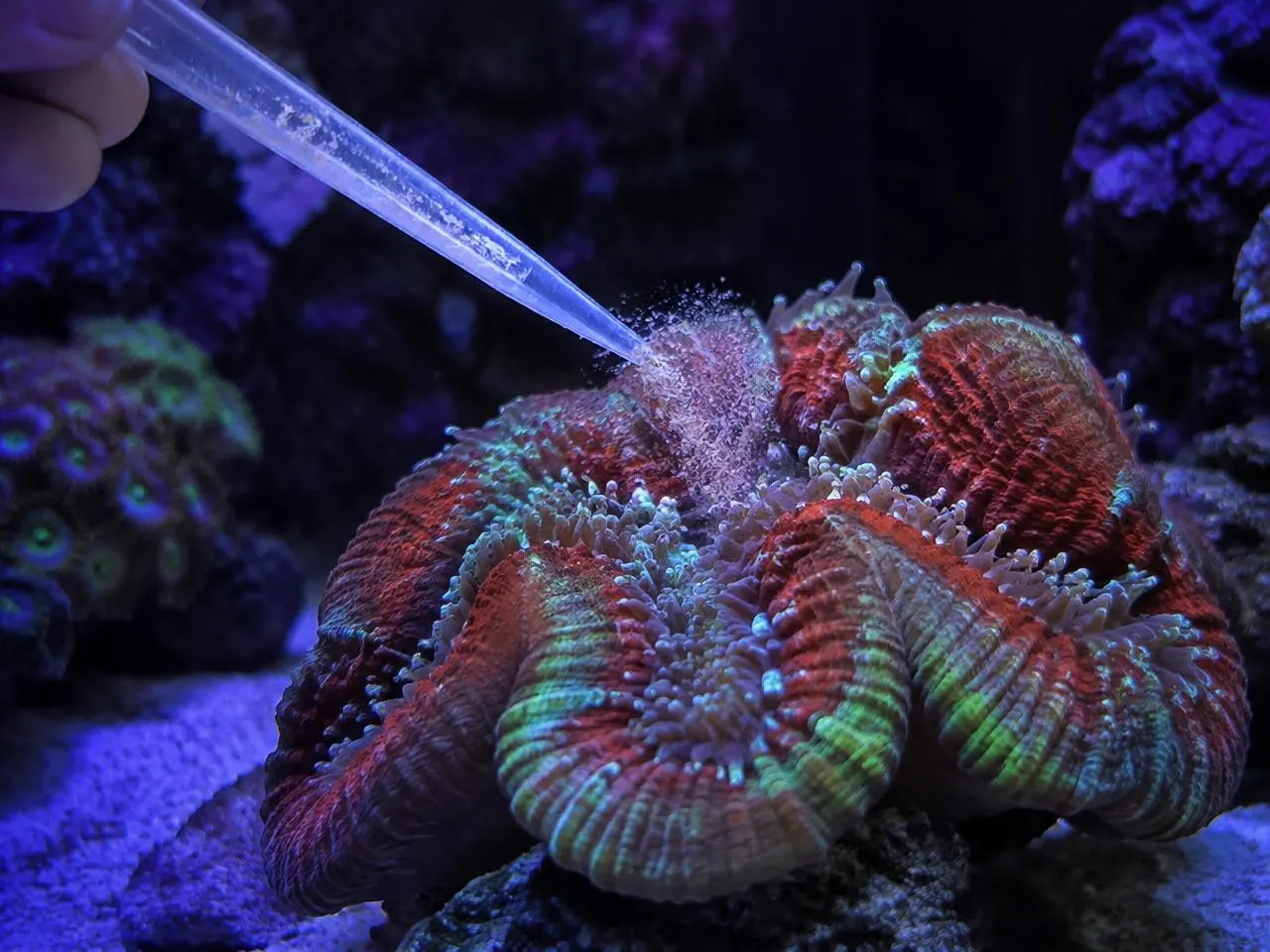
A pipette target feeding mysis shrimp to a colorful LPS coral with its feeding tentacles out

Best practices

How to spot feed, step by step

  1. 1

    Wait for tentacles

    Most LPS put out feeding tentacles about 30 minutes after the lights go off. That's the best time to feed.

  2. 2

    Thaw and rinse

    Thaw frozen food in a cup of tank water, then rinse it in a fine net so the packing juice doesn't add nutrients.

  3. 3

    Feed the fish first

    Toss a little food in for the fish on the other side of the tank so they don't steal from your corals.

  4. 4

    Turn the flow down

    Pause or lower your powerheads (and skimmer) for 10–20 minutes so food stays put. Use a feeding mode if your pump has one.

  5. 5

    Target feed gently

    Use a turkey baster or long pipette to place food right on the mouth or tentacles. Puff fine foods slowly over the colony.

  6. 6

    Turn pumps back on

    Set a timer so pumps always come back on. Remove any food the coral spits out after an hour.

Tools that help: a turkey baster or long target-feeding pipette, a fine brine-shrimp net for rinsing, a feeding dome for sand-bed corals and a pump with a feed mode or timer. We carry all of them.

Coral by coral

What each coral likes to eat

Same coral groups as our coral compatibility chart, so you can check light, flow and feeding in one place.

Mushrooms & ricordea

Discosoma · Rhodactis & Bounce · Ricordea Yuma · Ricordea Florida

Coral guide
Powdered coral foodAmino acids
How often
Optional — every 1–2 weeks
Best time
Lights on or off

Mostly fed by light. Rhodactis and bounce mushrooms will close around a pinch of fine food or a single mysis dropped on the disc.

It's eating when: Disc folds or cups closed around the food.

Zoanthids & palythoa

Zoanthids · Palythoa · Yellow Polyps

Coral guide
Powdered coral foodRotifers, oyster eggs & copepodsAmino acids
How often
1–2 times a week
Best time
Lights on, polyps open

Puff a fine paste over the colony with low flow. Palys and larger zoas will also grab small brine or mysis.

It's eating when: Polyps curl inward and close over the food.

Leather corals

Toadstool Leather · Finger Leather

Coral guide
Amino acidsPowdered coral food
How often
Optional — weekly at most
Best time
Lights on, polyps extended

Leathers live on light and absorb food from the water. A light cloud of powdered food near the polyps is plenty.

It's eating when: Polyps pull in briefly after feeding.

Fast-spreading softies

Kenya Tree · Pulsing Xenia · Green Star Polyps · Clove Polyps

Coral guide
Amino acids
How often
Not needed
Best time
—

Kenya trees, xenia, star and clove polyps feed themselves from light and the water. Skip target feeding — extra food just fuels algae.

It's eating when: Steady growth is all the proof you need.

Photosynthetic gorgonians

Photosynthetic Gorgonians

Coral guide
Powdered coral foodRotifers, oyster eggs & copepodsLive phytoplankton
How often
2–3 times a week
Best time
Polyps extended (often evening)

Drift fine foods up-current so the flow carries them through the branches.

It's eating when: Fuzzy, fully extended polyps that close as food hits them.

Torch, hammer & frogspawn

Torch Coral · Hammer & Octospawn · Frogspawn

Coral guide
Enriched brine shrimpFrozen mysis shrimpCoral pellets
How often
1–2 times a week
Best time
Evening, tentacles out

Touch a few pieces into the tentacles — don't bury the coral. Torches like small pieces; hammers and frogspawn take a little more.

It's eating when: Tentacles get sticky and pull food toward the mouth.

Acans, lobos & duncans

Acan · Echinata · Blastomussa · Lobophyllia · Duncan · Candy Cane

Coral guide
Frozen mysis shrimpCoral pelletsEnriched brine shrimp
How often
2–3 times a week
Best time
After lights out, feeding tentacles up

One mysis or pellet per mouth. Wait a few minutes for feeding tentacles to come out, then feed each head.

It's eating when: Mouths close and the polyp puffs up over the next hour.

Scolys, buttons & brains

Scolymia · Cynarina (Button) · Acanthophyllia · Open Brain

Coral guide
Frozen mysis shrimpChopped seafood (krill, clam, shrimp)Coral pellets
How often
1–3 times a week
Best time
After lights out, feeding tentacles up

Use a feeding dome or cover so fish and shrimp can't steal it. Place food right on the mouth and leave flow low for 15–20 minutes.

It's eating when: The mouth closes and the coral folds over the food.

Favia, favites & chalice

Favia & Favites · Chalice

Coral guide
Coral pelletsFrozen mysis shrimpRotifers, oyster eggs & copepods
How often
1–2 times a week
Best time
After lights out

Favia and chalice put out tentacles at night. Puff small foods over the colony so each mouth catches some.

It's eating when: Little mouths close; color and growth improve over weeks.

Bubble & plate corals

Bubble Coral · Plate Coral

Coral guide
Frozen mysis shrimpChopped seafood (krill, clam, shrimp)
How often
1–2 times a week
Best time
Evening, tentacles out

Bubbles deflate at night to show tentacles — feed then. Plate corals have one big mouth in the center; feed right into it.

It's eating when: Tentacles grip the food and pull it in.

Goniopora & alveopora

Goniopora & Alveopora

Coral guide
Rotifers, oyster eggs & copepodsLive phytoplanktonPowdered coral food
How often
Several times a week, small amounts
Best time
Lights on, polyps out

Goniopora need regular fine foods. Dose small amounts often with the pumps lowered, and run good filtration to handle it.

It's eating when: Long, fluffy polyp extension day after day.

Montipora, birdsnest & cyphastrea

Montipora · Birdsnest · Cyphastrea

Coral guide
Powdered coral foodRotifers, oyster eggs & copepodsAmino acids
How often
Optional — 1–2 times a week
Best time
Lights off or low

Broadcast feed — a light cloud of fine food into the flow. No need to target each colony.

It's eating when: Better color and faster encrusting edges over time.

Pocillopora & stylophora

Pocillopora · Stylophora

Coral guide
Powdered coral foodRotifers, oyster eggs & copepods
How often
Optional — 1–2 times a week
Best time
Lights off or low

Broadcast fine foods into the flow near the colony.

It's eating when: Polyps extend at night and catch particles.

Acropora

Acropora

Coral guide
Rotifers, oyster eggs & copepodsPowdered coral foodAmino acids
How often
Optional — small broadcast feeds
Best time
Lights off or low

Acropora get most of what they need from light. Fine broadcast feeding can boost color, but keep nutrients steady and low.

It's eating when: Fuzzy polyp extension and deeper color.

Coral foods

Which food is which?

Frozen mysis shrimp

Medium (3–6 mm)

Small whole shrimp packed with protein — the number one coral food for big-mouthed LPS.

Best for: Acans, lobos, scolys, brains, bubble and plate corals, torches and hammers

Thaw a cube in a cup of tank water and rinse it in a fine net to keep the packing juice out of your tank.

Enriched brine shrimp

Small (1–3 mm)

Soft, easy-to-swallow shrimp. Pick enriched kinds — plain brine has little nutrition.

Best for: Euphyllia, duncans, candy canes and smaller LPS

A good starter food for corals that are still learning to eat in your tank.

Chopped seafood (krill, clam, shrimp)

Large chunks

Pea-sized pieces of raw, unseasoned seafood or frozen krill.

Best for: Big scolys, open brains, acanthophyllia and plate corals

Never bigger than the coral's mouth. If the coral spits it out after an hour, take it out.

Coral pellets

Small (1–3 mm)

Sinking pellets made for LPS mouths. Easy to store and portion.

Best for: Acans, favia, chalice, lobos and duncans

Soak pellets in tank water for a minute so they sink and stick instead of floating away.

Powdered coral food

Fine (powder / micro)

Fine particles that drift in the water for polyps to catch.

Best for: Zoas, palys, SPS, gorgonians and goniopora

Mix with tank water into a paste, then puff it gently over the colony. A little goes a long way.

Rotifers, oyster eggs & copepods

Fine (powder / micro)

Tiny live or frozen plankton — the natural food of small-polyp corals.

Best for: SPS, goniopora, gorgonians, zoas and blastomussa

Live copepods do double duty: they feed corals and breed in your rock and refugium.

Live phytoplankton

Fine (powder / micro)

Microscopic algae that feed pods and filter feeders, which in turn feed your corals.

Best for: Goniopora, gorgonians and keeping your copepod population going

Dose a little daily and turn the skimmer off for 30–60 minutes so it isn't pulled right out.

Amino acids

Fine (powder / micro)

Liquid building blocks that soft corals and SPS absorb straight from the water.

Best for: Leathers, mushrooms, spreaders, zoas and SPS color

Dose sparingly — extra aminos feed algae as much as corals.

Avoid these

Common feeding mistakes

  • Overfeeding

    Uneaten food turns into nitrate, phosphate and algae. Small portions a few times a week beat one big dump.

  • Food too big

    If it's bigger than the coral's mouth, it won't get eaten. Chop it or pick a smaller food.

  • Forgetting the pumps

    Leaving powerheads off too long drops oxygen. Use a timer or your controller's feed mode.

  • Feeding a stressed coral

    New or closed-up corals can't eat. Give new arrivals a few days to settle before target feeding.

  • Skipping the rinse

    Frozen food juice is basically liquid fertilizer for algae. Always rinse.

  • Feeding at the wrong time

    Most LPS hide their feeding tentacles in daylight. Feed them at noon and you mostly feed your fish and algae.

Feeding adds nutrients, so test nitrate and phosphate regularly. Not sure your levels are right? Use our water parameter checker or bring in a sample.

Need coral food or a feeding pipette?

We stock frozen foods, coral pellets, powdered foods, live phyto and copepods, and target feeders. If we don't have it, we'll order it in.

Questions

Coral feeding FAQ

Do corals need to be fed?

Most corals get much of their energy from light, but many LPS, goniopora and gorgonians grow faster and color up better with regular feeding. Soft corals like kenya trees and star polyps don't need target feeding at all.

What time of day should I feed corals?

Most LPS put out feeding tentacles about 30 minutes after the lights go off, so evening is best. Zoas, goniopora and gorgonians can be fed while their polyps are open during the day.

How often should I spot feed my corals?

One to three times a week works for most LPS. Goniopora do best with small amounts several times a week. Feed less if nitrate or phosphate start climbing.

Should I turn off my pumps when feeding corals?

Yes, turn powerheads and the skimmer off or down for 10–20 minutes so the food stays on the coral. Use a timer or a feed mode so they always come back on.

What is the best food for LPS corals?

Rinsed frozen mysis shrimp is the favorite for acans, lobos, scolys and brains. Coral pellets and enriched brine shrimp are good backups. Match the food size to the coral's mouth.

Where can I buy coral food in Sarasota?

We carry frozen foods, coral pellets, powdered foods, live phyto, copepods and target-feeding pipettes at 1882 Porter Lake Dr unit 106, Sarasota FL 34240. Call (941) 431-9410 to check stock.

Talk to a real reefer

Looking for a coral or fish? Give us a call.

We'll tell you what's in stock today, ship it to you (in-store stock is first come, first served), and help you plan your tank. Open Monday–Saturday 11 AM – 7 PM, Sunday 12 PM – 5 PM.
Call now Directions Shop