Testing phase · purchases coming soon

Dosing, flow & nutrient export

Steady water, happy reef.

What all the dosing words mean, how to raise or lower every number on your test kit, and how flow and nutrient export keep your tank clean — explained in plain English.

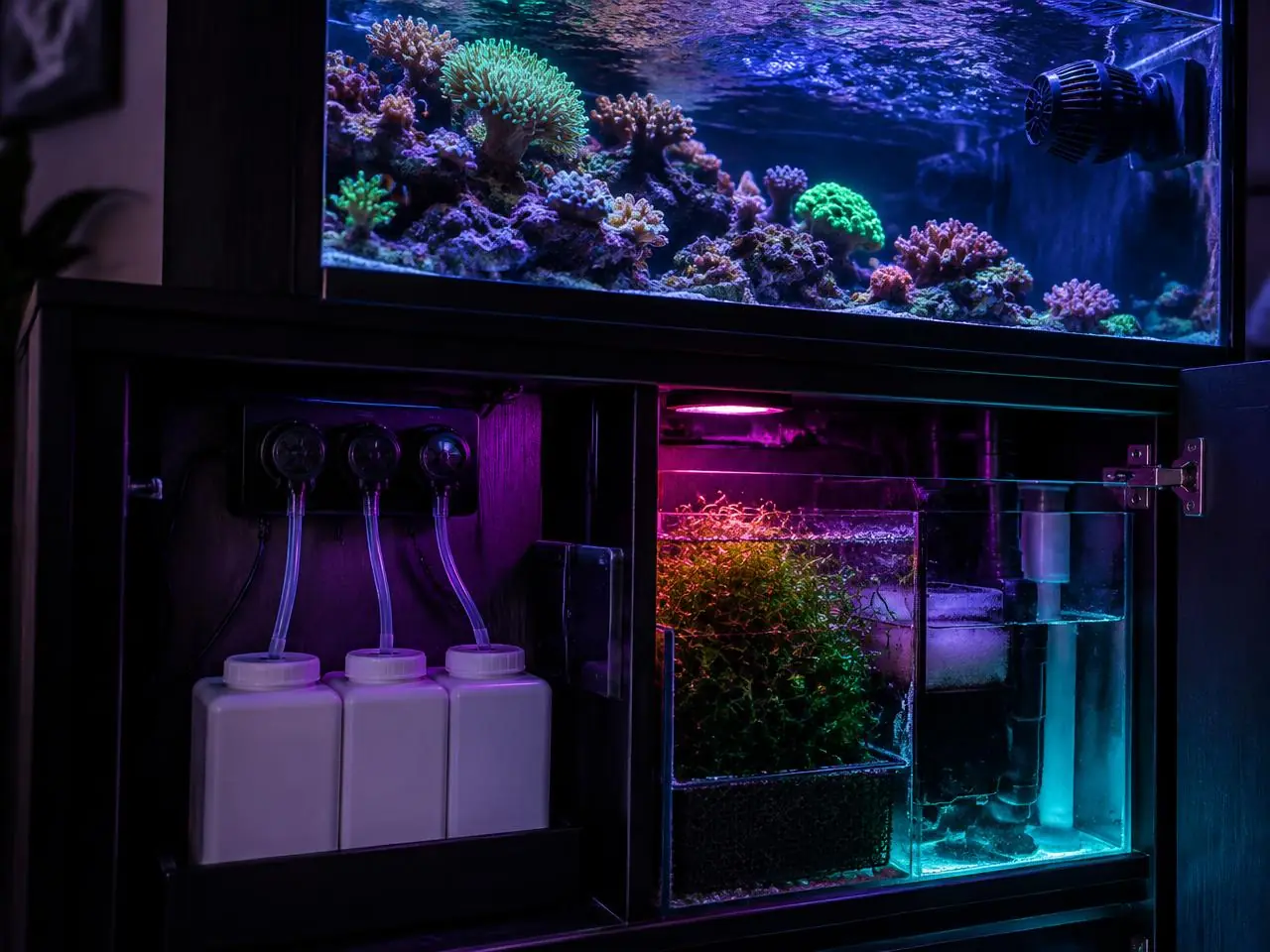
Reef tank above a sump cabinet with a three-head dosing pump, refugium chaeto under a purple light and a protein skimmer

Dosing words

What it all means

The words and units you'll see on supplement labels, test kits and forums.

Dosing
Adding a measured amount of a supplement to your tank on a schedule to replace what corals and coralline algae use up.
Daily consumption
How much of something (usually alkalinity) your tank uses in one day. Your daily dose should match it so levels stay flat.
dKH
Degrees of carbonate hardness — an older alkalinity unit some test kits and labels still print. About 18 ppm equals 1 dKH, so we show alkalinity in ppm.
meq/L
Another alkalinity unit. 1 meq/L is about 50 ppm, so 3 meq/L is about 150 ppm.
ppm
Parts per million (same as mg/L). Used for alkalinity, calcium, magnesium, nitrate and phosphate.
ppb
Parts per billion — 1,000 times smaller than ppm. Used for trace elements like iodine and iron, and some phosphate checkers.
SG / ppt
Specific gravity and parts per thousand — two ways to read salinity. 1.025–1.026 SG is about 35 ppt, natural seawater.
Major elements
Alkalinity, calcium and magnesium — the big three stony corals use to build their skeletons.
Trace elements
Tiny amounts of things like iodine, iron, potassium and strontium. Water changes usually cover them; dose only if testing shows you need to.
Two-part
Dosing alkalinity (part A) and calcium (part B) from two separate jugs, usually with a dosing pump. Magnesium is sometimes a third part.
Balling method
A three-part dosing system (alkalinity, calcium and a trace/salt part) designed to keep the water's overall balance close to seawater.
All-in-one
A single bottle that adds alkalinity, calcium, magnesium and traces together. Simple, but you can't adjust one number without the others.
Kalkwasser (kalk)
Calcium hydroxide mixed into top-off water. Adds alkalinity and calcium and raises pH. Must be dripped slowly — never dumped in.
Calcium reactor
A chamber of media dissolved by CO₂ that feeds alkalinity, calcium and magnesium back in. Best for big SPS tanks with high demand.
Dosing pump
A small programmable pump that adds tiny doses through the day for steady levels. Apex DOS and stand-alone dosers both work.
Buffer
A product that raises alkalinity (and holds pH steady). Baking soda and soda ash are common buffers.
Carbon dosing
Adding a carbon source (vodka, vinegar or a reef product) to feed bacteria that eat nitrate and phosphate. Needs a good skimmer.
Swing
A fast up-or-down change in a number. Swings stress corals more than a steady number that's slightly off target.
Stability
Keeping numbers flat day to day. In reefing, stable beats perfect.
Test → dose → retest
The golden rule: test first, change the dose a little, then test again before changing anything else.

More hobby words are in our reef glossary.

Ways to dose

Which dosing method fits your tank?

Water changes only

Best for: Fish-only tanks, soft corals, mushrooms and new reefs with few stony corals.

Good: Fresh salt mix brings everything back up and adds trace elements. No extra gear.

Watch out: Can't keep up once stony corals start growing — numbers drop between changes.

Dosing by hand

Best for: Small tanks and light demand, or while you're figuring out your daily use.

Good: Cheap and easy to start. Good way to learn what your tank uses.

Watch out: Easy to forget, and one big daily dose causes swings. Split doses if you can.

Two-part with a dosing pump

Best for: Most mixed reefs and LPS/SPS tanks of any size.

Good: Small automatic doses all day keep alkalinity and calcium very stable. Easy to fine-tune.

Watch out: A dosing pump is an upfront cost. Keep the two parts on separate lines, dosed in different spots.

All-in-one solution

Best for: Beginners and nano reefs that want one bottle.

Good: One jug, one pump channel, simple routine.

Watch out: Everything goes up together, so you can't fix just calcium or just alkalinity.

Kalkwasser

Best for: Tanks with an auto top-off that need extra alkalinity, calcium and a pH boost.

Good: Raises pH, cheap, and doses itself as water evaporates.

Watch out: Limited by how much water evaporates. Too much at once spikes pH — use a slow doser or reactor.

Calcium reactor

Best for: Large, SPS-heavy tanks using a lot of alkalinity.

Good: Handles huge demand and adds magnesium and traces too.

Watch out: Expensive, needs CO₂ and dialing in, and tends to lower pH.

Find your dose

How to set your daily dose

Every tank uses a different amount. Measure yours, match it, and keep checking as corals grow.

  1. 1

    Make sure magnesium is right

    Test magnesium first and bring it to about 1,300–1,400 ppm. When magnesium is low, alkalinity and calcium won't hold no matter how much you dose.

  2. 2

    Measure your daily use

    Stop dosing and test alkalinity at the same time of day for 3 days. Subtract the last reading from the first and divide by the days — that's your daily drop.

  3. 3

    Work out the dose

    Use your supplement's label or calculator to see how much it takes to raise your tank's real water volume by your daily drop. That's your starting daily dose.

  4. 4

    Split it up

    Spread the dose across the day — several small doses on a pump, or at least morning and night by hand. Dose alkalinity and calcium in different spots, at least 15 minutes apart.

  5. 5

    Retest and nudge

    Test every couple of days. If the number still drifts, change the dose by about 10% at a time and give it 3 days before changing again.

  6. 6

    Keep checking as corals grow

    Growing corals use more each month. Test alkalinity at least weekly and raise the dose when it starts slipping.

How much does my tank use?

Test alkalinity with no dosing, wait a few days, test again.

Your tank uses about 5.3 ppm of alkalinity and 2.1 ppm of calcium a day.

Set your daily dose to replace that much, split through the day.

Change each parameter

How to raise or lower every number

Reef target ranges match our water test checker. Always change slowly — the safe pace is listed on each card.

Alkalinity

Reef target: 125–196 ppm

The buffer that keeps pH steady and that stony corals use to build skeletons. The number that changes fastest and matters most.

To raise

  • • Alkalinity part of a two-part, or a buffer (baking soda raises alk without moving pH much; soda ash raises alk and pH)
  • • Kalkwasser in top-off water
  • • Water changes with a good salt mix

To lower

  • • Stop or reduce dosing and let corals use it up
  • • Water changes with a salt mix closer to your target
  • • Never add acid to lower it

Safe pace: No more than about 18 ppm per day.

Calcium

Reef target: 380–450 ppm

Stony corals, clams and coralline algae build with it. Moves together with alkalinity — about 7 ppm for every 18 ppm of alkalinity used.

To raise

  • • Calcium part of a two-part (calcium chloride)
  • • Kalkwasser
  • • Calcium reactor on big tanks

To lower

  • • Stop calcium dosing and let it drift down
  • • Water changes

Safe pace: About 20–25 ppm per day.

Magnesium

Reef target: 1250–1400 ppm

Keeps calcium and alkalinity from falling out of the water. Low magnesium makes the other two impossible to hold.

To raise

  • • Magnesium supplement (magnesium chloride + sulfate blend)
  • • Water changes

To lower

  • • Skip magnesium doses — it drops slowly on its own

Safe pace: About 100 ppm per day.

pH

Reef target: 7.8–8.4

How acidic or basic the water is. It swings a little from day to night, and that's normal.

To raise

  • • Fresh outside air to the skimmer intake (indoor CO₂ is the usual cause of low pH)
  • • Kalkwasser
  • • Run a refugium light at night, opposite the main lights
  • • Make sure alkalinity is in range

To lower

  • • Slow down kalkwasser or soda ash
  • • Retest after a day — high pH is usually from dosing too much at once

Safe pace: Change slowly; aim for steady day-to-day readings.

Nitrate

Reef target: 2–20 ppm

Leftover from fish waste and food. Corals need a little; too much fuels algae and dulls color.

To raise

  • • Feed a little more, or add a fish
  • • Ease off nutrient export (shorter refugium light, less carbon dosing)
  • • Nitrate supplement for ultra-low tanks

To lower

  • • Feed less and rinse frozen food
  • • Water changes
  • • Refugium with chaeto, skimmer, carbon dosing (see Nutrient export below)

Safe pace: Lower it over weeks, not days — corals can bleach if it crashes.

Phosphate

Reef target: 0.02–0.1 ppm

Comes from food. Corals need a trace; too much feeds hair algae and slows stony coral growth.

To raise

  • • Feed more
  • • Remove or reduce phosphate remover (GFO)
  • • Phosphate supplement for bottomed-out tanks

To lower

  • • Feed less, rinse frozen food
  • • Phosphate remover in a reactor or media bag — start with half the label amount
  • • Water changes, refugium, skimmer

Safe pace: Bring it down slowly — dropping too fast can pale corals.

Salinity

Reef target: 1.024–1.026 SG

How salty the water is. Evaporation only removes fresh water, so salinity creeps up if you don't top off.

To raise

  • • Top off with saltwater for a few days, or use a slightly stronger batch at your next water change

To lower

  • • Top off with RODI fresh water only, a little at a time
  • • An auto top-off keeps it steady for you

Safe pace: About 0.001 SG per day for tanks with fish and corals.

Temperature

Reef target: 76–80 °F

Affects everything else. Pick a number and keep it steady.

To raise

  • • Check your heater's setting; use two smaller heaters on tanks over 75 gallons

To lower

  • • Fans across the water, lights on for fewer hours, a cooler room, or a chiller

Safe pace: 1–2 °F per day.

Ammonia & nitrite

Reef target: 0 ppm

Toxic waste from the nitrogen cycle. Should always read zero in an established tank.

To lower

  • • Stop feeding and do a water change
  • • Remove anything dead
  • • Add bottled nitrifying bacteria
  • • Don't add livestock until both read zero

Safe pace: Fix right away — any reading is a problem.

Potassium

A trace element that helps coral color. Usually fine with regular water changes.

To raise

  • • Potassium supplement — only if a test shows it's low

To lower

  • • Stop dosing and do water changes

Safe pace: Small steps, with a retest each time.

Iodine

Used by shrimp when molting and by some soft corals. Easy to overdose.

To raise

  • • Iodine supplement — only after testing

To lower

  • • Stop dosing; fresh carbon and water changes remove it

Safe pace: Dose small. Too much is worse than too little.

Want each coral type's ideal numbers? See the parameter panels on our coral guide.

Flow

Flow: why it matters and how to set it

Flow brings food and oxygen to corals, carries waste to your filter and keeps detritus from settling.

Turnover

How many times an hour your pumps move the whole tank's water. Reefs want about 20–40× an hour from powerheads; fish-only tanks about 10–15×.

Return flow

The water your sump pump sends back to the display. Aim for about 3–5× the tank volume an hour through the sump, so the skimmer and filter socks can do their job.

Laminar flow

A straight, steady stream. Fine for moving water across a long tank, but blasting a coral in one spot can tear its tissue.

Random / turbulent flow

Water coming from several directions. This is what corals see on a real reef, and it keeps detritus floating up to your filter.

Wave & pulse modes

Powerheads ramping up and down or alternating sides. Great for SPS and for keeping coral polyps clean.

Surface agitation

Ripples on top of the water swap CO₂ for oxygen. More ripple = more oxygen and a higher, steadier pH.

Signs of too little flow

  • • Detritus (brown gunk) settling in corners and behind rocks
  • • Red slime (cyano) or film on the sand
  • • Corals coated in a film or slime
  • • Low pH and stringy, stretched-out polyps

Signs of too much flow

  • • Polyps stay closed all day
  • • Tissue pulling back or tearing on soft-fleshed LPS
  • • Sand blowing around and piling up
  • • Fish struggling to swim or hiding all the time

How to change your flow

  1. 1

    Spread it out

    Two or more smaller powerheads beat one big one. Put them on opposite or side walls so streams meet and break up.

  2. 2

    Kill dead spots

    Look for where detritus piles up — that's a dead spot. Aim a powerhead or tilt your return nozzle toward it.

  3. 3

    Point at the surface

    Angle one pump or the return nozzle up so the top of the water ripples. You get more oxygen and better pH.

  4. 4

    Match corals to flow

    Put SPS in strong, random flow up high, LPS in gentle-to-medium flow lower down, and soft corals and mushrooms in calm spots.

  5. 5

    Use the modes

    Run a wave or random mode by day, a gentler night mode, and a feed mode that pauses pumps while you feed.

  6. 6

    Change slowly

    Raise power about 10% at a time and watch your corals for a few days. Watch how polyps react — open and swaying gently is just right.

Find your tank's flow target with the reef calculators, and see which corals like low, medium or high flow on the coral compatibility chart.

Shop in catalog

Nutrient export

Nutrient export: getting waste out

Everything you feed turns into nitrate and phosphate. Nutrient export is how you take them back out so you get healthy corals instead of algae.

Water changes

Removes: Nitrate, phosphate, organics

Swapping old water for new removes waste and brings back trace elements.

Tip: About 10% weekly is a good habit. Use RODI water and match temperature and salinity.

Protein skimmer

Removes: Organics before they break down

Fine bubbles grab waste and carry it into a cup you empty.

Tip: Clean the cup every few days. A wetter skim pulls more; a drier skim pulls less.

Filter socks & roller mats

Removes: Uneaten food, detritus

Catches particles before they rot into nitrate and phosphate.

Tip: Swap socks every 2–3 days. A dirty sock is a nutrient factory.

Refugium with chaeto

Removes: Nitrate, phosphate

Macroalgae grows in the sump under its own light and soaks up nutrients. Prune it to take them out for good.

Tip: Run the light opposite your display lights to also steady pH at night.

Algae scrubber

Removes: Nitrate, phosphate

Grows turf algae on a screen under bright light, then you scrape it off.

Tip: Powerful on fish-heavy tanks. Clean on a regular schedule.

Phosphate remover (GFO)

Removes: Phosphate

Media that grabs phosphate out of the water.

Tip: Start with half the label amount in a reactor or bag — it can drop phosphate too fast.

Activated carbon

Removes: Organics, yellow tint, coral toxins

Soaks up dissolved organics so the water stays clear.

Tip: Change it every 3–4 weeks. Great in soft-coral tanks.

Carbon dosing

Removes: Nitrate, phosphate

A carbon source feeds bacteria that eat nitrate and phosphate; the skimmer pulls the bacteria out.

Tip: Start very small and only with a working skimmer. Stop if water gets cloudy.

Live rock & sand

Removes: Ammonia, nitrite, some nitrate

Bacteria on and inside rock and sand break waste down.

Tip: Siphon the top of the sand during water changes so it doesn't trap gunk.

Clean-up crew

Removes: Leftover food, film algae, detritus

Snails, hermits and conchs eat waste before it breaks down.

Tip: Doesn't remove nutrients on its own — it turns waste into something your filter can catch.

Nutrients too high? (algae, dull corals)

  1. Feed less and rinse frozen food in RODI water before feeding.
  2. Change filter socks more often and keep the skimmer cup clean.
  3. Do a couple of extra water changes.
  4. Add or grow your refugium (chaeto) or an algae scrubber.
  5. For phosphate, add a phosphate remover at half strength and retest in a few days.
  6. Lower slowly over a few weeks — crashing nutrients can bleach corals.

Nutrients bottomed out? (pale corals)

  1. Feed more, or add another fish.
  2. Cut back the refugium light hours or remove some chaeto.
  3. Use less phosphate remover or carbon dosing, or take it out.
  4. Skim a little drier.
  5. If it's still near zero, dose a small amount of nitrate or phosphate supplement.
  6. Many reefers aim for nitrate about 100 times higher than phosphate (for example 5 ppm nitrate with 0.05 ppm phosphate).

Starting a refugium? Our macroalgae guide covers chaeto and other refugium algae.

Avoid these

Common dosing mistakes

  • Chasing a perfect number

    A steady 150 ppm beats bouncing between 125 and 180. Pick a target and hold it.

  • Changing several things at once

    Change one dose at a time. Otherwise you'll never know what helped or hurt.

  • Dosing alk and calcium together

    Mixing them in one spot makes white snow (precipitate) and wastes both. Use separate spots and times.

  • One big dose

    A big daily dose spikes pH and alkalinity. Split it into many small doses.

  • Trusting one test

    If a number looks way off, retest or bring a sample to the shop before you change anything.

  • Dosing traces blind

    Only dose iodine, potassium or iron if a test says you need it — too much can do more harm than too little.

Not sure what your tank needs?

Bring a water sample in for testing and we'll help you plan your dosing, flow and filtration. We carry dosing pumps, supplements, test kits, powerheads, skimmers and refugium gear — and if we don't have it, we'll order it in.

Questions

Dosing, flow & nutrient FAQ

What does dKH mean?

dKH (degrees of carbonate hardness) is an older alkalinity unit some test kits still print. We show alkalinity in ppm instead: about 18 ppm equals 1 dKH, so most reef tanks do well between 125 and 196 ppm.

How fast can I raise alkalinity in a reef tank?

No more than about 18 ppm per day. Raising it faster can stress or burn corals. Fix magnesium first if alkalinity won't hold.

Do I need to dose my reef tank?

Fish-only tanks and soft-coral tanks usually don't — weekly water changes are enough. Once LPS and SPS corals start growing, they use alkalinity and calcium faster than water changes replace, so most reefers start dosing.

What is two-part dosing?

Two-part means dosing alkalinity and calcium from two separate jugs, usually with a dosing pump. Dose them in different spots and at different times so they don't react with each other.

How do I lower nitrate and phosphate?

Feed less, rinse frozen food, change filter socks every 2–3 days, do water changes, run a protein skimmer and add a refugium with chaeto. Use a phosphate remover at half strength for phosphate. Lower both slowly over weeks.

How much flow does a reef tank need?

About 20–40 times the tank volume per hour from powerheads for a reef, and 10–15 times for fish-only tanks, with flow coming from more than one direction so there are no dead spots.

Can you help me figure out my dosing in Sarasota?

Yes. Bring a water sample to 1882 Porter Lake Dr unit 106, Sarasota FL 34240 and we'll test it and help you plan dosing, flow and filtration. Call (941) 431-9410 with questions.

Talk to a real reefer

Looking for a coral or fish? Give us a call.

We'll tell you what's in stock today, ship it to you (in-store stock is first come, first served), and help you plan your tank. Open Monday–Saturday 11 AM – 7 PM, Sunday 12 PM – 5 PM.

Call now Directions Shop