Testing phase · purchases coming soon

PAR light planner

Map the light in your tank.

Pick your reef light, how high it hangs and your tank size. See how much light (PAR) reaches every depth, in inches and centimeters, and a 3" × 3" block map of your whole tank. Have a PAR meter? Type in your readings too.

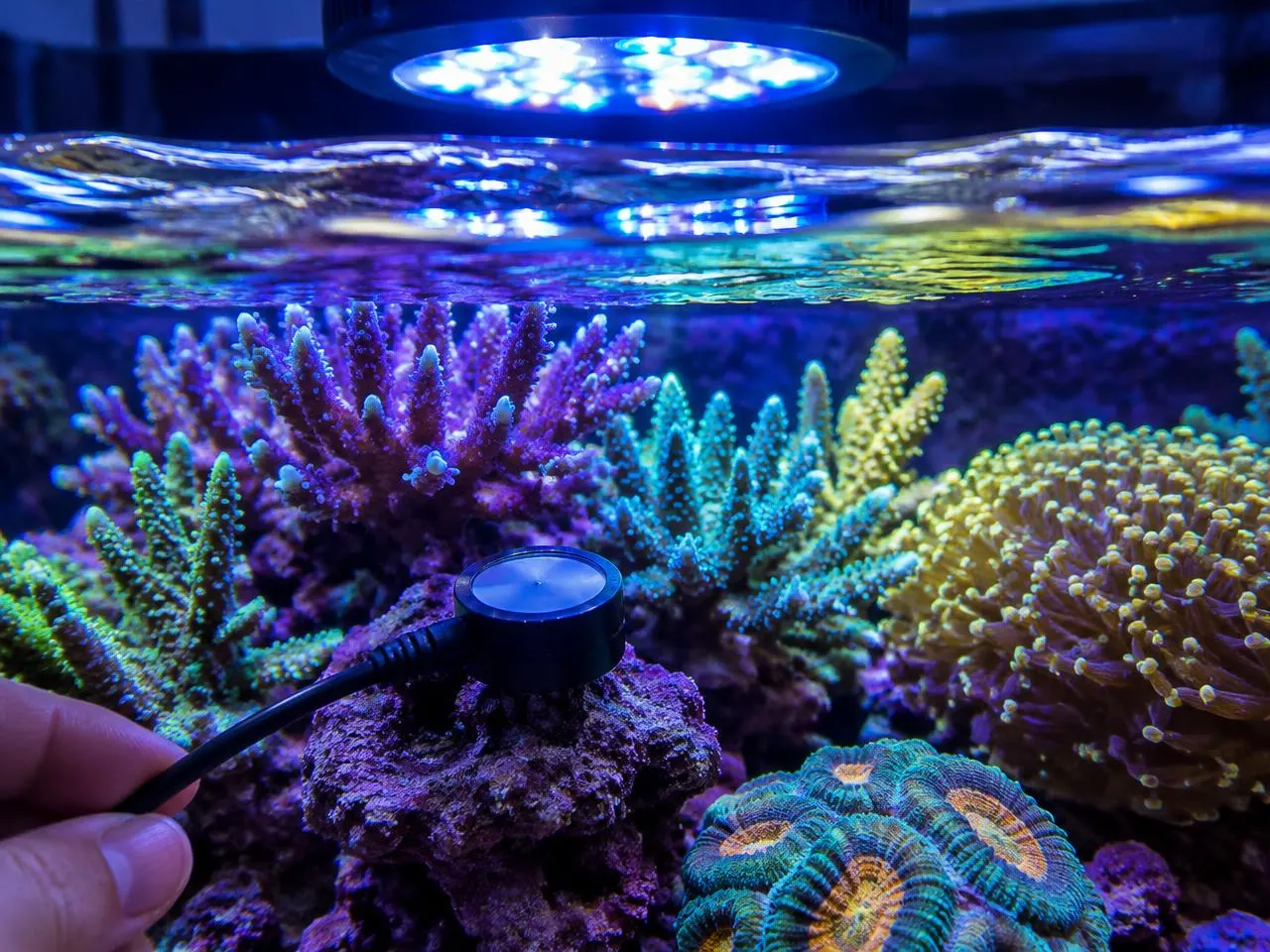
A PAR meter sensor held on a rock among colorful corals under a reef LED light

Your tank & light

Plug in your setup

Everything updates as you type, and we save it on this device.

Tank size

Map: 12 × 6 blocks of 3" × 3" (7.6 × 7.6 cm).

Your light

Water & glass

At a glance

  • Just under the surface: 713 PAR
  • On the sand under a light: 155 PAR
  • Darkest sand spot: 72 PAR

These are estimates from typical readings for each light at 100% on every channel. Real numbers depend on your settings, the light's age and your tank — a PAR meter is the only way to know for sure.

PAR by depth

How the light drops as it goes down

Every 3 inches (7.6 cm) from the surface to the sand. "Under a light" is straight below your first fixture.

Depth (in)Depth (cm)Under a lightTank averageDarkest spotLeft vs. surface
Surface0 cm71324665
100%
3"7.6 cm49721874
70%
6"15.2 cm36819179
52%
9"22.9 cm28516780
40%
12"30.5 cm22814779
32%
15"38.1 cm18612976
26%
18" (sand)45.7 cm15511472
22%

Block map

Your tank in 3" × 3" blocks

Looking down from above, with the front glass at the bottom. Click any block to add rock height or your PAR meter reading.

  • Under 50
  • 50–100
  • 100–250
  • 250–400
  • 400+
  • Light
  • My reading

Back glass

Front glass

▲ = rock in that block (the number is at the top of the rock). Blocks with a white border show your own meter reading.

Meter readings

Have a PAR meter? Add your real numbers

  1. 1

    Run your normal schedule

    Measure at the peak of your light schedule, with your usual settings and pumps running.

  2. 2

    Keep the sensor level

    Point the sensor straight up. Tilting it toward the light gives a falsely high number.

  3. 3

    Measure where corals sit

    Read the sand, the top of each rock and the spots you plan to place corals. Note the depth of each reading.

  4. 4

    Type them into the map

    Click a block, enter the rock height if there is rock there, and type your reading. We'll compare it with the estimate.

No readings yet. Click a block on the block map and type in your meter reading.

Shop in catalog

What changes PAR

Why your numbers can differ

Light placement

PAR is highest straight under each light and fades toward the glass and corners. Raising a light spreads it wider but makes it weaker; lowering it makes a brighter, smaller hot spot. Spacing several lights evenly is what makes a long tank even.

Intensity setting

Dimming to 50% cuts PAR roughly in half everywhere. Blue-heavy schedules often read lower on a meter than they look to your eye. Change intensity a little at a time — corals bleach when light jumps quickly.

Depth

Light spreads out as it travels, so PAR drops fast in the first few inches and more slowly after that. A coral at the bottom of a 24" tall tank can get less than half the light of one near the top.

Water flow at the surface

Ripples bend and scatter light. That makes a nice shimmer and softens hot spots, but a very choppy surface can cost 5–15% of your PAR.

Water quality

Yellow water (from skipping carbon), cloudy water, algae on the glass and salt creep on the light's lens all block light. Clean the lens and run carbon to get back what you're paying for.

Rockwork

The top of the rock sits closer to the light, so it gets far more PAR than the sand. Overhangs, caves and the back of the rock are shaded — coral there gets a lot less than this map shows.

Glass reflection

Bare glass bounces some light back into the tank, so spots near the glass read a little higher. A black or painted back wall reflects much less.

Light age and spectrum

LEDs fade slowly over the years, and every spectrum reads differently. Use a full-spectrum quantum (PAR) meter, and re-check your tank once a year or after you change settings.

How much light do corals need?

  • Under 50 PAR

    Too dim for most corals — shaded mushrooms at most

  • 50–100 PAR

    Low light — mushrooms, ricordea and other low-light corals

  • 100–250 PAR

    Moderate — most LPS, soft corals and zoas

  • 250–400 PAR

    High — SPS, clams and light-loving zoas

  • 400+ PAR

    Very high — top-of-rock SPS only; acclimate new corals slowly

Light levels match our coral compatibility chart. Need help choosing a light? See Radion & AI lights.

Want help lighting your tank?

We carry EcoTech Radion and the full AI lineup, plus mounts and PAR meters. Tell us your tank size and corals and we'll help you pick the right light, how many and how high to hang them.

Questions

PAR & reef lighting FAQ

What is PAR in a reef tank?

PAR (photosynthetically active radiation) is the amount of light corals can actually use to make food. It's measured with a PAR meter in µmol/m²/s, usually just called "PAR". Most soft corals and LPS like 100–250, SPS like 250–400.

How much does PAR drop with depth?

A lot in the first few inches, then more slowly. With a typical reef light about 9" above the water, a 20" deep tank often reads only a third to a half as much on the sand as it does just under the surface. Raising the light evens that out but lowers PAR everywhere.

Do I need a PAR meter?

Not to start, but it's the only way to know your real numbers. Estimates like our planner get you close; a meter shows the real hot spots and shaded areas so you can place corals with confidence.

Why are the corners of my tank darker?

Light is strongest straight under each fixture and spreads out toward the glass. Adding a light, spacing lights more evenly, raising them a little or adding a strip light along the front all help even out the corners.

Can you help me check the PAR in my tank in Sarasota?

Yes. Call (941) 431-9410 or stop by 1882 Porter Lake Dr unit 106, Sarasota FL 34240 and we'll help you pick, place and set up the right reef light for your tank.

Talk to a real reefer

Looking for a coral or fish? Give us a call.

We'll tell you what's in stock today, ship it to you (in-store stock is first come, first served), and help you plan your tank. Open Monday–Saturday 11 AM – 7 PM, Sunday 12 PM – 5 PM.

Call now Directions Shop